Amanda Gauß
Amanda Gauß CSO | Medical Product Advisor
Telefonnummer +49 7232 3029-0
E-Mail Adresse a.gauss@hahnenkratt.com

About us

90 years dental excellence – made in germany

Contact persons

Your contact for questions, solutions, and advice

Social commitment

Social commitment that makes a difference — locally and worldwide, for children, families, and people in need.

Career

Welcome to the HAHNENKRATT team.

Job Storys

Insights into the daily work and innovative strength of the HAHNENKRATT team.

EXATEC Titanium posts (refill)

EXATEC Titanium posts (refill)

EXATEC Titanium posts (refill)

RRP74,31 € from 74,31 € excl. VAT

REF 4231X

Size:
Product contains 10 Pieces per PU

"Not logged in yet? Log in or sign up for free to access all features!"

To registration / login

Product description

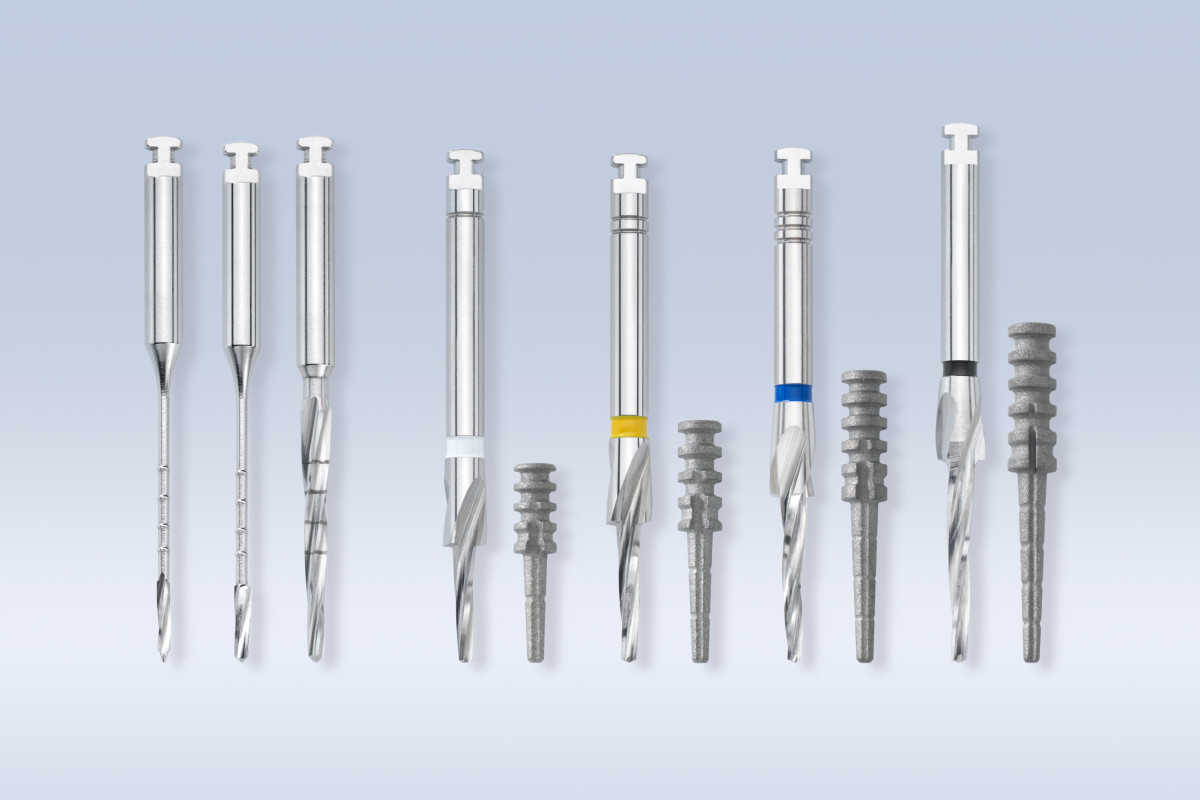
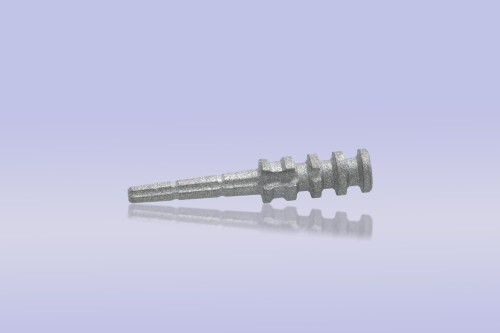
Exatec–Ti: Passive titanium root posts with a micro-rough surface.

Optimization of the stability of the root reconstruction
The conical apical part has the advantage that it can be designed longer than a cylindrical shape and has an exceptionally small end. This allows the conical Exatec post to be inserted deep into the root canal.

  • 2 cement escape grooves

  • large post cross-section (> 3 mm²) and rounded juncture provide high strength

  • rounded tip

Explore the details

The System

A root post with a tapered apical part offers many advantages over a cylindrical post:

Due to the tapered shape, which corresponds to the natural contour of the tooth root, more tooth substance is preserved in the critical area of the root tip, thus minimizing the risk of root fractures.

At the transition from post to head, which is prone to breakage, the tapered Exatec post has rounded transitions and a larger post cross-section compared to a cylindrical post of the same apical length. The Exatec post thus has higher stability and achieves higher values in bending load tests.

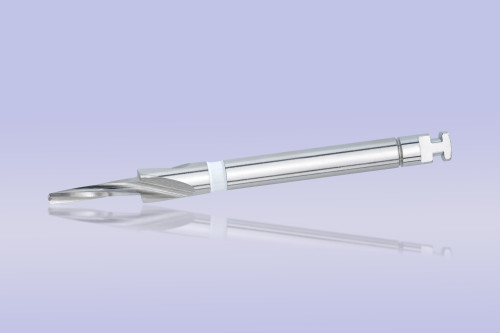
The Exatec calibration drill prepares a precisely fitting axial support for the Exatec post head, which inherently determines the position where the post has dentin contact without exerting pressure on the root wall, as the downward movement of the post is precisely stopped at the axial support.

The precise support ensures the axial support of the post head in the dentine and stops precisely the movement of post to the apical direction.


The Exatec Calibration Drill with integrated head cutter calibrates a precise support.

Downloads

Download our comprehensive resources now and receive valuable information, product catalogs, and more for your practice.

eIFU & Processing EXATEC, CYTEC & CONTEC
Format: pdf
Size: 1.4 MB
Version: 2024-10 Index 04
81.01 EXATEC Titan
Format: pdf
Size: 553 KB
Version: 2025-12

Related Products

Root Post Systems
REF 4231XC5
EXATEC Titanium posts (refill) from 38,64 € excl. VAT Product contains 5 Pieces per PU
Root Post Systems
REF 42300
EXATEC Titanium Standard Set 127,20 € excl. VAT Product contains 1 Pieces per PU
Root Post Systems
REF 4200X
Calibration drill EXATEC from 5,74 € excl. VAT Product contains 1 Pieces per PU

FAQ - Products

In this section, you will find answers to frequently asked questions about our dental instruments, as well as information on the materials, manufacturing, properties, and applications of our products.

Titanium root posts: High rigidity, but higher risk of root fractures
HT glass fiber root posts: Better force distribution, dentin-like modulus of elasticity to minimize root fractures

1. CYTEC 
• Material: HT glass fiber (High Tenacity)
• Shape: Cylindrical-conical
• Surface: Micro-retentive, no silanization needed
• Application: For roots that are mostly cylindrical
• Available in various diameters (e.g., 1.0 mm to 2.1 mm)

2. CONTEC
• Material: HT glass fiber (High Tenacity)
• Shape: Double cone
• Surface: Micro-retentive
• Application: For roots with a conical shape

3. EXATEC
• Material: HT glass fiber or titanium (EXATEC-Ti & EXATEC-S)
• Shape: Conical in the apical area, some with a post head
• Surface: Micro-retentive (for glass fiber versions)
• Application: Especially suitable for teeth with severely destroyed coronal areas

 

The main difference between FS (Front Surface) and RS (Rear Surface) lies in the position of the reflective coating and the resulting image quality:

1. FS (Front Surface) mouth mirror

  • Reflective coating: The reflective layer is on the front side of the glass
  • Materials: Often coated with rhodium or ULTRA coating for high durability, brightness, and chemical resistance
  • Image quality:
    • Only a single reflection, resulting in an extremely sharp, distortion-free mirror image
    • No double images or “ghost images”
    • Excellent color accuracy and contrast


2. RS (Rear Surface) mouth mirror

  • Reflective coating: The reflective layer is on the rear side of the glass
  • Materials: Features a silver coating, protected by a copper/titanium layer for high resistance to disinfection and sterilization
  • Image quality:
    • Two reflections
    • May produce double images (“ghost images”)
    • Bright mirror image, but less precise than FS mirrors

The new pro modules feature the same outstanding qualities as the trusted CONTEC and CYTEC root posts, which have been proven for over 30 years, especially through:

  • Optimized flexural strength
    • HT glass fiber, translucent: 1,430 MPa (according to EN ISO 178)
    • HT glass fiber, opaque: 1,400 MPa (according to EN ISO 178)
  • Optimized resistance to fatigue and fracture
  • Dentin-like modulus of elasticity for restorative homogeneity
  • Optimized, strong bond to composite materials
  • high radiopacity

pro LightTransmitting along the entire apical area of the post enables optimized and at the same time shortened initial curing of the composite, right up to the tip of the root post. In a tightly scheduled workflow, every second counts, providing valuable time savings so the dentist can proceed immediately to the next step without delay.

HAHNENKRATT mouth mirrors are manufactured with high-quality mirror coatings and precision components.

Front surface mirrors (FS) prevent double images and provide a clear, distortion-free view.
Depending on the model, different coating technologies are used to optimize brightness, contrast, and durability.

This results in reliable optical quality for precise work in everyday dental practice.

The abbreviations SS and CS refer to the thread types of mouth mirrors and their compatibility with handles:

SS (Simple Stem)
Used in Europe and other regions

CS (Cone Socket)
Conical thread (Cone Socket).
Especially common in the USA, Canada, South Korea, and Spain.

Do you have any questions or would you like product advice?

Mrs. Gauß, our medical product advisor, will be happy to assist you.

AG HAHNENKRATT NOV04

Amanda Gauß

CSO | Medical Product Advisor